
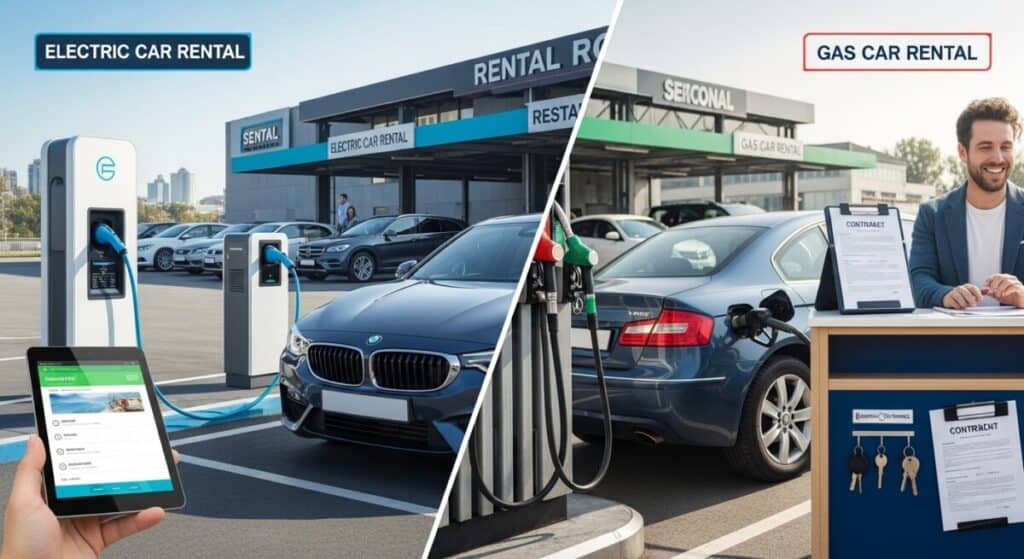
If you are deciding between an electric rental and a gas car, the best choice usually comes down to trip length, charging access, and how much convenience matters on the road. The environmental case matters too, but for most renters the real question is simpler: which option will be easier, cheaper, and less stressful for this specific trip?
Quick decision guide
- Choose electric if you are staying mostly in the city, have reliable charging where you are parked, or want a quieter drive with lower running costs.
- Choose gas if you are covering long distances, traveling through rural areas, or want the simplest pickup-and-go option with no charging planning.
- Check the rental details first: charging cable access, return charge rules, fuel policy, mileage limits, and where you can realistically refuel or recharge.
If you already know you want an EV-focused rental, it makes sense to start with the dedicated electric-car rental guide. If you are still weighing both options, the comparison below focuses on what actually changes your trip.
| Decision factor | Electric car rental | Gas car rental |
|---|---|---|
| Best for | City trips, short-to-medium drives, predictable routes, and travelers comfortable planning charging stops. | Road trips, remote destinations, short notice rentals, and trips where simplicity matters more than efficiency. |
| Energy cost | Often cheaper per mile, especially if charging is affordable at the hotel, home, or workplace. | Usually higher and more variable because fuel prices can change quickly by region and season. |
| Time spent refueling | Charging takes longer, even with fast chargers, so it works best when the trip naturally includes stops. | Refueling is quick and easy, which makes gas cars more flexible for spontaneous travel. |
| Range anxiety | Can matter if you are unfamiliar with the area or charging network, especially in winter or on highways. | Usually minimal because fuel stations are widespread and range is easier to predict on long drives. |
| Pickup and return | May require return-charge rules, charging cable checks, or a little extra planning before drop-off. | Usually easier to return because you only need to follow the fuel policy and refill if required. |
| Overall convenience | Best when your trip fits the charging rhythm and you value a quieter, smoother drive. | Best when you want the least complicated rental experience from pickup to drop-off. |
How to choose the right rental for your trip
The best rental is not the one with the best reputation in the abstract. It is the one that matches your route, your schedule, and your tolerance for extra planning. That is why the same electric car can be ideal for a downtown stay and frustrating on a wide-open highway route.
Choose a gas car when flexibility matters more than efficiency
Gas cars are usually the safer default when you are covering long distances, making multiple unplanned stops, or traveling in an area where charging stations are sparse. They are also easier for one-way airport trips, late arrivals, and itineraries that can change at the last minute.
If your main goal is to compare prices across different vehicle types, it helps to look at the broader rental market first. A general pricing overview like how rental prices stack up can show whether the EV premium, if any, is actually meaningful for your dates and destination.
Trip types where each option usually wins
| Trip scenario | Usually better pick | Why |
|---|---|---|
| City break with hotel parking | Electric | Short drives, slower pacing, and built-in parking time make charging easier to manage. |
| Airport pickup with a packed schedule | Gas | You can leave the lot and drive without thinking about charging stations or battery levels. |
| Long-distance road trip | Gas | Refueling is faster and easier to find, especially where charging networks are thinner. |
| Mostly urban driving | Electric | Stop-and-go traffic and lower daily mileage fit EV range and efficiency well. |
| Rural areas or unfamiliar regions | Gas | Fuel stations are still easier to rely on when you are not sure about charger density. |
| Scenic trip with planned stops | Either | An EV can work if the route and chargers are mapped out in advance; gas is simpler if you want spontaneity. |
Budget, fees, and the real rental cost
Electric rentals are not automatically cheaper, and gas rentals are not always the bargain option. The true cost depends on the daily rate, local fuel or charging prices, mileage rules, and whether the rental company charges extra for return conditions.
What changes the price most
- Daily rental rate and how far in advance you book.
- Local fuel prices versus charging prices at hotels, public chargers, or commercial stations.
- Mileage restrictions and overage fees.
- Return rules, especially for EVs that may require a minimum charge level.
- Insurance, damage protection, and any special vehicle category surcharge.
If you are trying to control the full trip budget, it can help to read what rental costs usually include before deciding on the vehicle type. That way, you are comparing the total price instead of just the headline daily rate.
Fuel policy matters more than most renters expect
For gas cars, the main question is usually whether you must return the tank full or pay the rental company’s refueling rate. For EVs, the parallel issue is whether you must return the car charged to a set level. Understanding those rules in advance avoids surprise fees and makes the comparison fair.
A clear breakdown of those rules is available in this fuel policy guide, and it is especially useful if you are comparing an EV return charge with a conventional full-tank requirement.
Convenience factors that can change the decision
The practical difference between electric and gas rentals is often felt before the trip even begins. Availability, pickup speed, and how comfortable you are with the vehicle’s operating rules can matter as much as the per-mile cost.
Availability
Gas cars are still more widely available, especially for last-minute rentals. EV fleets are growing, but the best model in the class you want may be limited.
Learning curve
EVs are easy to drive, but charging etiquette, plugs, and station apps can add friction if you have never used one before.
Comfort
EVs are quieter and can feel smoother in city traffic, while gas cars often feel more familiar to most travelers.
Trip flexibility
Gas cars handle detours and long days better when you do not want to build the route around charging stops.
If you are comparing providers as well as vehicle type, start with a broader booking guide such as how to choose a rental company. The company’s EV policy, charger support, and pickup process can be just as important as the car itself.
When the environmental angle should influence your choice
The environmental advantage of electric rentals is real, but it works best as a tiebreaker when the practical factors are already manageable. EVs reduce tailpipe emissions, can lower local air pollution, and support quieter city driving. That said, if charging access is poor or your itinerary is tight, a gas car may still be the better travel decision.
For travelers whose main priority is reducing emissions, the EV-focused page is still the best next stop: rent an electric car online. This comparison guide is here to help you decide whether EV planning fits the trip you actually have.
A simple booking checklist
- Check your route length and whether you can charge or refuel easily.
- Compare the total rental cost, not just the daily rate.
- Confirm mileage limits and return conditions.
- If choosing EV, verify charger access where you will stay and along the route.
- If choosing gas, check the fuel policy so you know how to return the car.
- Choose the option that reduces stress, not just the one that sounds more advanced.
Ready to choose?
If you want the simplest trip, a gas car is usually the safer default. If you want a quieter, lower-emission drive and your route supports charging, an EV can be an excellent rental.
For a more direct eco-friendly rental path, visit the electric car rental page. If you are still comparing overall rental prices, the broader cost guide can help you judge whether the difference is worth it for your dates.
Frequently asked questions
Is an electric rental cheaper than a gas rental?
Sometimes, but not always. Electric rentals can save money on energy, yet the daily rate, charging costs, mileage limits, and return rules determine whether the overall trip is actually cheaper.
Are EVs harder to rent for first-time drivers?
Not harder to drive, but they do require more planning. First-time EV renters usually need to understand charging options, station apps, and the car’s range before leaving the lot.
What is the biggest advantage of a gas car rental?
Convenience. Gas cars are easier to refill quickly, more familiar to most travelers, and usually better when the route is flexible or the destination is not charger-friendly.
When does an electric car make the most sense?
Electric cars make the most sense for city stays, shorter routes, and trips where you can charge overnight or while parked for several hours.
Should I worry about charging stations on a road trip?
Yes, if you choose an EV. For long drives, charger density and route planning matter. If you do not want that extra layer of planning, a gas car is usually the easier choice.

Clara Bennett is a passionate writer and expert in the world of car rentals, focusing on providing insightful guidance for affordable options available online. With years of experience in travel and a keen understanding of the industry, she aims to simplify the car rental process for her readers. Clara’s engaging articles and practical tips help travelers navigate the complexities of securing the best deals, making her a go-to resource for anyone looking to save money on their next adventure.




It’s fascinating to see how electric vehicles (EVs) are transforming our approach to transportation—especially in urban areas where the impact on air quality is so immediate. I remember reading a study that highlighted how cities embracing EVs not only improved air standards but also experienced a boost in public health outcomes, like reduced asthma rates among children. It seems that the shift to electric is more than just about cutting emissions; it’s about fostering healthier communities.
Your analysis of the environmental impact of electric vehicles vis-à-vis traditional gasoline cars is indeed timely and thought-provoking. As cities around the world grapple with pollution and air quality issues, the shift towards electric cars seems not only beneficial but necessary for sustainable urban living.
I appreciate how you highlighted the environmental benefits of electric vehicles in your post. It’s such an important topic, especially with climate change becoming an ever-pressing issue. I’ve been on the fence about whether to switch to an electric car myself, but the points you made about reducing local air pollution really resonate with me, particularly because I live in a densely populated city where the smog can sometimes feel suffocating.
I appreciate the insights shared in this post, particularly the emphasis on the significant reduction of harmful emissions associated with electric vehicles (EVs). It’s interesting to reflect on how this shift is gradually reshaping not only our transportation methods but also our urban landscapes and public health narratives.
It’s intriguing to see how electric vehicles (EVs) are not only changing our transportation landscape but also making a significant impact on our environment. The reduction in pollutants like CO2 and NOx highlights a pressing need for more sustainable urban living, especially considering the air quality issues faced by many cities today.
It’s great to see your interest in the environmental benefits of electric vehicles (EVs). Beyond just lowering CO2 and NOx emissions, EVs encourage cities to rethink their infrastructure. For instance, the shift towards EV-friendly designs, like dedicated charging stations and improved public transit options, can make urban spaces more walkable and accessible.
You’ve hit on a really important point about the broader implications of EVs in urban planning. I’ve noticed that as cities start to embrace electric vehicles, there’s this ripple effect that leads to more sustainable designs overall. It’s not just about the cars themselves, but how they fit into the fabric of urban life.
Your breakdown of the environmental impact of electric vehicles resonates deeply with the ongoing conversations about sustainability and urban living. It’s fascinating to think about how shifting to electric cars not only addresses pollution but also supports public health in our cities. My own experience renting electric vehicles has opened my eyes to their potential; during a recent trip, I noticed how much quieter and cleaner the driving experience was, especially in areas that are usually congested with traffic.
It’s great to hear that your rental experiences with electric vehicles have given you a fresh perspective. The quieter, cleaner driving experience you described really highlights how the transition to electric cars can enhance urban living. It’s interesting to think about how noise pollution is often overlooked in our discussions about transportation and its effects on health. I’ve read studies linking chronic exposure to noise pollution with increased stress levels and health risks, so the reduction in noise from EVs could play a significant role in promoting public well-being.
I just came across some insights on eco-friendly car rentals that really tie into our discussions about sustainability—it’s intriguing how choosing the right vehicle can enhance both our travel experience and urban health.
‘Eco-Friendly Car Rentals: When To Choose Hybrid Or Electric Options’
https://online.rentacar24.org/rent-a-car-online-eco-friendly-options-for-green-travel/.
I’m really glad you brought up the comparison between electric vehicles (EVs) and gas cars. It’s such a relevant topic, especially as cities are grappling with air quality issues. I recently took an electric car for a weekend trip, and I was amazed by how quiet and smooth the ride was compared to my old gas vehicle. The sensation of driving without all that engine noise really shifts the experience!
It’s great to hear about your experience with electric vehicles. I totally agree that the difference in ride quality can be quite striking, especially when you’re used to the hustle and bustle of a gas engine. The quietness does change the whole vibe of driving—it almost feels like you’re floating along instead of rumbling down the road.
I totally relate to that feeling. Driving an electric vehicle does have a unique vibe—it’s like you get this whole new perspective on the road. It’s interesting how the quiet ride can really heighten your awareness of your surroundings. Sometimes I find myself noticing things I would have overlooked in a traditional car, like the subtle sounds of nature or the little details of the streets I drive on.
Your insights on the environmental impact of electric vehicles are essential in today’s conversation about sustainable transportation. I find it fascinating how the shift to electric cars not only reduces harmful emissions but also encourages the development of cleaner energy sources. For instance, as more people embrace EVs, there’s a growing need for renewable energy infrastructures, such as solar and wind power, which could transform our energy consumption on a larger scale.
It’s fascinating to see how the shift towards electric vehicles is not just a technological revolution but also a significant public health initiative. Living in a city where air quality issues are a daily concern, I’ve personally felt the benefits of cleaner air since more EVs have been adopted. It’s not just about emissions; the reduction in noise pollution is another underrated advantage that impacts our urban life.
Ah, the age-old question of whether to embrace the futuristic charms of electric vehicles or stick with the tried-and-true (albeit guzzling) gasoline models. As someone who’s spent way too many weekends debating which is the better choice over a cup of organic, ethically-sourced fair-trade coffee, I’d like to chime in with my two cents—partly for my love of carbon footprints but mostly for the solid puns I can make about them!
I appreciate the critical examination of the environmental impacts of electric versus gasoline cars presented in this article. The distinction made between the emissions of electric vehicles (EVs) and traditional gas-powered vehicles is particularly relevant today as we grapple with the urgent need to address climate change and air quality issues, especially in urban environments.
The discussion around electric vehicles (EVs) versus gasoline cars is not only timely but critical, given the current climate crisis and the urgent need for sustainable transportation solutions. Your emphasis on the reduced emissions from EVs particularly resonates with the broader conversation about urban air quality and public health.
I completely agree with the points about the environmental benefits of electric vehicles. Living in a city with poor air quality, I can really feel the impact that emissions have on health. It’s not just about reducing CO2; it’s also about giving future generations a better chance at a cleaner planet.
I really appreciate you diving into the environmental aspect of electric vehicles versus gas cars. It’s fascinating how the shift to electric not only addresses pollution but also ties into broader issues like public health and urban planning. I’ve noticed that cities with more electric vehicles tend to have better air quality overall, which makes a huge difference, especially when you think about places with high population densities.
I couldn’t agree more that electric cars are taking the emissions battle by storm! It’s like watching a superhero movie where EVs are the caped crusaders, swooping in to save the day (and our lungs) from the dastardly gas guzzlers.
Your exploration of the environmental impacts of electric vehicles compared to gasoline cars resonates deeply, particularly in light of ongoing global discussions about sustainability and public health. It’s fascinating to consider how the shift to electric vehicles (EVs) not only serves as a solution to reduce emissions but also as a catalyst for broader societal change.
Your analysis of the environmental impact of electric vehicles (EVs) versus gasoline cars truly highlights a crucial shift in how we conceptualize transportation. I appreciate the focus on urban environments, as these areas face significant air quality challenges. In my experience living in a city with heavy traffic, it’s evident how much cleaner the air feels on days when electric taxis or rideshares dominate the streets. It’s almost palpable.
It’s great to hear your thoughts on the cleaner air in urban areas when electric vehicles are more prevalent. Living in a city where traffic can be relentless, the difference on those quieter, cleaner days is certainly noticeable. It’s fascinating to consider how the shift to EVs not only affects air quality but also contributes to an overall change in the urban landscape. With fewer emissions, it’s not just about cleaner air; there’s also the potential for less noise pollution and a more inviting atmosphere for pedestrians and cyclists.
This is such an important topic, and I appreciate how you’ve approached it with depth and clarity. The transition from gasoline to electric vehicles undoubtedly signals a major shift in our transportation landscape and in our collective response to climate change. I’ve always been curious about the broader implications of this shift, particularly in urban areas where air quality is such a pressing concern.
Your exploration of the environmental impact of electric vehicles (EVs) compared to traditional gasoline cars raises some fundamental questions about our collective approach to transportation and pollution. Having transitioned to an electric vehicle myself several months ago, I can truly appreciate the transformative benefits of this shift not just on an individual level but for society as a whole.