
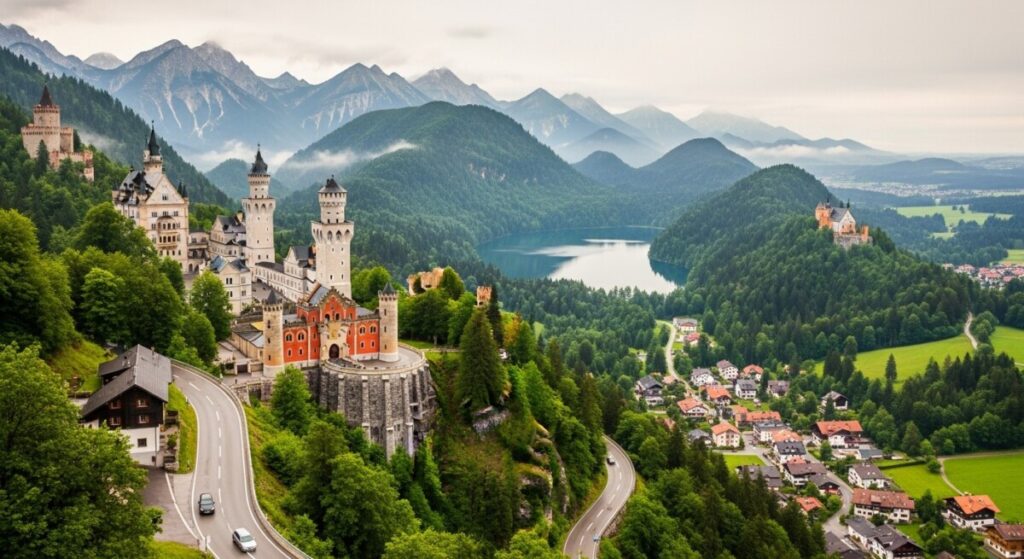
A Bavarian castles road trip works best when you treat it as a route-planning exercise, not just a sightseeing list. The sweet spot is a drive built around Neuschwanstein, Füssen, Oberammergau, and the scenic roads that connect them.
If you are shaping a wider Germany itinerary, start with these Germany road trip ideas and then narrow your route to Bavaria for the castle-focused leg.
What This Route Is Best For
Why Castles Make This Drive Memorable
Castles are more than dramatic landmarks. Their stone walls, towers, battlements, and grand entrances turn a simple drive into a route with historical texture and strong visual payoff. In Bavaria, that mix is especially effective because the scenery changes quickly from alpine edges to village streets and wooded hills.
Neuschwanstein is the obvious headline stop, but it is the surrounding geography that makes the route worth planning carefully. Füssen gives the drive a practical base, while nearby Hohenschwangau and the wider Alpine foothills add enough variety to justify at least an overnight stay.
If you want a fuller driving framework before booking your Bavaria leg, the practical guidance in this Germany driving guide is a useful companion.
How To Plan The Route Without Overpacking It
The strongest Bavarian castle drives keep the route narrow enough to enjoy. Instead of trying to cover every fortress in southern Germany, build around one anchor area and add only a few nearby stops that fit the same day’s driving rhythm.
- Start with one flagship castle, usually Neuschwanstein.
- Add a practical base such as Füssen for food, parking, and an overnight stop.
- Use Oberammergau or a similar village stop only if it fits your time window.
- Leave room for scenic pull-offs, coffee breaks, and photo stops.
- Keep the route compact if you are traveling in high season.
That approach keeps the trip enjoyable and reduces the chance of turning a scenic drive into a rushed transfer day.
Best Time To Go, And When To Book
Timing matters more here than it does on a standard city break. Late spring and early autumn are the most balanced windows because they combine good weather, better road conditions, and fewer crowds than peak summer.
For Germany-wide route timing, road-trip planning ideas can help you decide whether the castle drive should be a standalone loop or part of a longer itinerary.
Driving Notes That Matter In Bavaria
Castle routes often look easy on a map, but mountain edges, winding approaches, and seasonal weather can change the experience quickly. A little discipline at the planning stage makes the drive feel calmer on the road.
- Check weather and road conditions before setting out.
- Keep your speed conservative on narrower scenic sections.
- Use designated pull-offs for photos instead of stopping unpredictably.
- Make sure tires, fuel, and navigation are ready before leaving your base.
- Leave margin for rest stops if you are connecting several castle towns in one day.
If you are renting a car for the trip, the right vehicle and the right pickup location can make the route much easier. This is where a Germany-specific rental search becomes relevant, especially if your itinerary starts in Munich or another gateway city.
Plan Your Bavaria Rental Next
A good castle drive is easier when the car, pickup point, and driving rules are settled early. If you are still comparing options, rent a car in Germany for a route-ready vehicle, then review Germany driving rules and tips before you book.
If you want the broader road-trip context first, the main Germany road trip guide is the best place to anchor the itinerary.
A Few Route Decisions Worth Making Early
- One-Day Or Overnight? Choose a day trip only if you want a single headline castle and a short scenic loop.
- Castle-First Or Scenery-First? Castle-first is better for first-time visitors; scenery-first works if you already know the region.
- Peak Season Or Shoulder Season? Shoulder season usually gives you the easiest drive and the best balance of crowds and weather.
- Direct Route Or Flexible Loop? A loop gives you more variety, but a direct route is safer if you have limited time.
What To Remember Before You Go
The original appeal of a Bavarian castles drive is still the same: history, architecture, and scenery packed into one trip. The difference now is planning. A focused route, the right season, and a safe driving rhythm turn the idea into a trip that feels polished rather than rushed.
If you keep the route centered on Bavaria, avoid overloading the day, and book your stay around the season you are traveling, the drive becomes much more rewarding than a simple castle checklist.
Frequently Asked Questions
What Is The Most Famous Castle In Bavaria?
Neuschwanstein is the best-known castle in Bavaria and the most common anchor point for a castle-focused road trip.
Is The Romantic Road In Germany Worth It?
Yes, especially if you want a multi-day drive that combines villages, historic towns, and easy add-on castle stops.
How Long Does It Take To Drive The Romantic Road In Germany?
The full route usually takes several days if you want to stop properly, but a Bavaria-only castle drive can be done in a day or two depending on how many sights you include.
Where Is Castle Road In Germany?
Germany’s Castle Road stretches across multiple regions, but it fits best as a broader historic route if you want to extend a Bavaria trip into a longer castle itinerary.
For readers who want to branch out beyond Bavaria, the broader Germany road trip ideas page is the natural next stop after you finish planning this castle route.

Clara Bennett is a passionate writer and expert in the world of car rentals, focusing on providing insightful guidance for affordable options available online. With years of experience in travel and a keen understanding of the industry, she aims to simplify the car rental process for her readers. Clara’s engaging articles and practical tips help travelers navigate the complexities of securing the best deals, making her a go-to resource for anyone looking to save money on their next adventure.


Ah, the allure of castles! It’s like they have their own gravitational pull, isn’t it? I mean, who wouldn’t want to stroll through ancient stone halls and imagine themselves dodging arrows during a medieval siege or planning an escape from a dragon? Much like you mentioned, every castle brings with it layers of history, and let’s be honest, they provide the perfect backdrop for a dramatic Instagram post (because, who wouldn’t want to caption a photo with “Feeling like royalty today”?).
Your exploration of the allure of castles is both intriguing and thought-provoking. Castles do indeed serve as tangible links to our past, and their architectural diversity offers a window into the cultural evolution of societies. Each fortification encapsulates not just the design ethos of its time but also the socio-political dynamics that shaped its construction and preservation. For example, the transition from defensive strongholds to ornate palatial residences reflects a significant shift in societal priorities—from survival to art and leisure.
You’ve really captured the essence of what makes castles so captivating! I’ve always been drawn to their stories, especially when visiting ones like Neuschwanstein in Bavaria. There’s just something magical about walking through those ancient halls and imagining the lives that unfolded there.
It’s funny, isn’t it, how a simple structure made of stone can capture our imaginations so completely? Your mention of Bavarian castles and their historical allure struck a chord with me. Just think about it: these massive fortresses were once the epicenters of power, intrigue, and, let’s face it, a fair dose of drama, not unlike the latest soap opera binge-watching session! I mean, how many episodes could we create about the romantic misadventures of a prince trapped in a castle with only his trusty steed for company?
Your exploration of why castles are so alluring resonates deeply with anyone who has experienced the mystique of these historic structures. It’s interesting how you highlight the blend of architectural grandeur and rich narratives. For many, visiting a castle feels like stepping into a time capsule, where the weight of history is palpable. This intangible connection to the past fuels both fascination and a deeper appreciation for the layers of human experience encapsulated within those walls.
Your insights about the allure of castles really resonate with me. The way you describe them as embodiments of history and architectural grandeur captures what many feel when visiting these magnificent structures. I’ve often found that stepping into a castle can feel like stepping back in time, especially when you consider the stories behind each stone—triumphs, betrayals, and the everyday lives of those who once walked the halls.
Ah, the allure of castles! It’s almost like they have an ancient Tinder profile, isn’t it? Swipe right for knightly ambiance and sweeping, dramatic views while swiping left on modern distractions. When you think about it, each castle is essentially a historical text, written in stone and mortar, detailing all the “royal drama” that house parties of yesteryear could barely contain. I mean, can you imagine the dinner conversations at a castle? “So tell me about your latest conquest… Oh, you mean the battle or the failed love affair?”
I really appreciate your insights on why castles hold such an allure for many of us. I often find myself drawn to their stories and the way they encapsulate the spirit of the times in which they were built. Each castle not only represents the architectural prowess of its era but also hints at the everyday lives of those who lived within its walls.
Your discussion on the allure of castles really resonates with me. Castles not only represent architectural marvels but also serve as tangible links to our past, each with its own narrative that speaks to the socio-political landscape of its time. For instance, visiting Neuschwanstein in Bavaria not only captivates with its fairy-tale aesthetics but also prompts reflections on King Ludwig II’s vision and the romanticism of the 19th century.
Ah, the allure of castles! There’s something truly magical about them, isn’t there? It’s like stepping into a time machine where you can almost hear the clanging of knights’ armor and the whispers of long-lost princesses. I once visited Neuschwanstein Castle, and let me tell you, I may or may not have practiced my “I am the true heir” speech just in case any nobles were still lurking around.
I appreciate your insights on the allure of castles and the importance of strategic planning for travel—it’s such a perfect blend of adventure and realism! Castles have always captivated me, not just for their majestic architecture but for the rich tapestries of stories woven into their stone walls. Each time I visit one, I feel a connection to the past; it’s like stepping into a different time, filled with knights, tales of courage, and even the everyday lives of those who lived there.
The allure of castles indeed lies in their rich historical narratives combined with awe-inspiring architecture. Each castle serves as a time capsule, inviting visitors to imagine the lives of the people who once inhabited them, from the nobility to the common folk. I particularly enjoy exploring how these structures often represent the cultural values and technological advances of their periods.
I really resonate with your thoughts on castles! They indeed have a unique charm that captivates the imagination. Each castle does have its own story, and visiting them often feels like stepping into a different time altogether. The architectural styles reflect not just historical periods but also cultural values and advancements.
I love your take on the allure of castles—they truly are gateways to the past! I often find that visiting these majestic structures sparks my curiosity about the lives that once played out within their walls. It’s fascinating to think about how each castle’s architecture tells a story aligned with the cultural and historical context of its time.
I love the focus on treating the drive as a route-planning exercise! It’s so easy to get caught up in checking off sights without considering how the journey itself can be part of the adventure. I did a road trip through Bavaria a couple of years ago, and I found that stopping at little towns along the way, like Garmisch-Partenkirchen, really added depth to the experience.
Ah, the Bavarian Castles Drive! I can practically hear the “Oompah” bands playing as I read through your post. Planning a road trip like this is a delightful blend of strategy and spontaneity, much like perfecting a good schnitzel—it takes precision but also a bit of an adventurous spirit.
It’s fascinating how you framed the Bavarian castles drive as a route-planning exercise rather than just a sightseeing quest! I’ve always found that the journey can be as rewarding as the destination itself, especially in a region with such rich history and stunning landscapes.
I appreciate the practical approach you’ve outlined for planning a Bavarian castles road trip. It’s so easy to get lost in the allure of the sights without thinking strategically about the journey itself. The emphasis on safety and understanding road regulations is often overlooked but crucial for a relaxing trip.
I thoroughly enjoyed your take on planning a road trip around the Bavarian castles—it’s such a charming topic that brings to mind the beauty and history of the region. Your emphasis on treating the journey as a strategic route-planning exercise rather than merely a list of sights resonates deeply with me. I firmly believe that the journey is as important as the destination, especially in a place as picturesque as Bavaria.
Your breakdown of the Bavarian castles road trip really resonates with me. I’ve always believed that the journey should be just as rewarding as the destinations themselves, and your checklist approach truly emphasizes that. The idea of considering safety, tolls, and weather before heading out is a fantastic reminder for anyone planning a road trip. It’s those little details that can really make or break the experience!